Why it matters
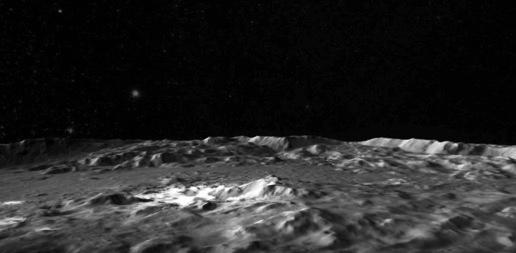
Gilgamesh connects impact morphology with Ganymede's more complex geology: grooves, bright terrains, and ancient surfaces.
Measurements and uncertainty
Diámetro153 km
Depthnot listed
Ageancient impact feature
EstadoConfirmado
Coordinates62.840° S / 124.830° W
Record levelminimal
Seed record: coordinates and diameter support navigation, while geology, age, and visual rights need enrichment.
Perfil científico
This minimal profile fixes coordinates, diameter, and context so it can later be expanded with imagery and geologic interpretation.
Data provenanceGazetteer of Planetary Nomenclature; NASA Image and Video Library
Galería de reconstrucción
Más lecturas visuales del cráter
Si la imagen verificada no basta, la ficha recibe una reconstrucción científica: no fantasía en lugar de dato, sino una hipótesis visual separada de las fuentes.
Paleta del mundoicy turquoise, deep space, and distant moons

Visual reconstruction
Reverse reconstruction → Chronological inversion → Bidirectional analysis → The present as an archive of the future
Cada ficha necesita una vista previa visual: una imagen existente, una fuente tratada estéticamente o una reconstrucción científica.
Historia de investigación
The name was adopted by the IAU in 1979, reflecting the tradition of naming Ganymede features from mythological stories.
Fuentes
- Last reviewed
- 2026-05-08
- Source baseline
- Gazetteer of Planetary Nomenclature; NASA Image and Video Library
- Uncertainty note
- Seed record: coordinates and diameter support navigation, while geology, age, and visual rights need enrichment.
Education mode
Datos
- Official diameter: about 153 km.
- The name refers to the Assyro-Babylonian epic.
- Useful for future comparison with lunar and Martian craters.