Why it matters
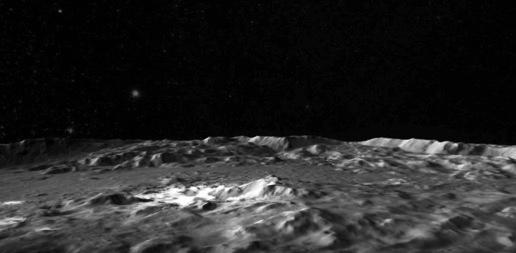
Gilgamesh connects impact morphology with Ganymede's more complex geology: grooves, bright terrains, and ancient surfaces.
Measurements and uncertainty
Diameter153 km
Depthnot listed
Ageancient impact feature
StatusConfirmed
Coordinates62.840° S / 124.830° W
Record levelminimal
Seed record: coordinates and diameter support navigation, while geology, age, and visual rights need enrichment.
Scientific profile
This minimal profile fixes coordinates, diameter, and context so it can later be expanded with imagery and geologic interpretation.
Data provenanceGazetteer of Planetary Nomenclature; NASA Image and Video Library
Reconstruction gallery
More visual readings of the crater
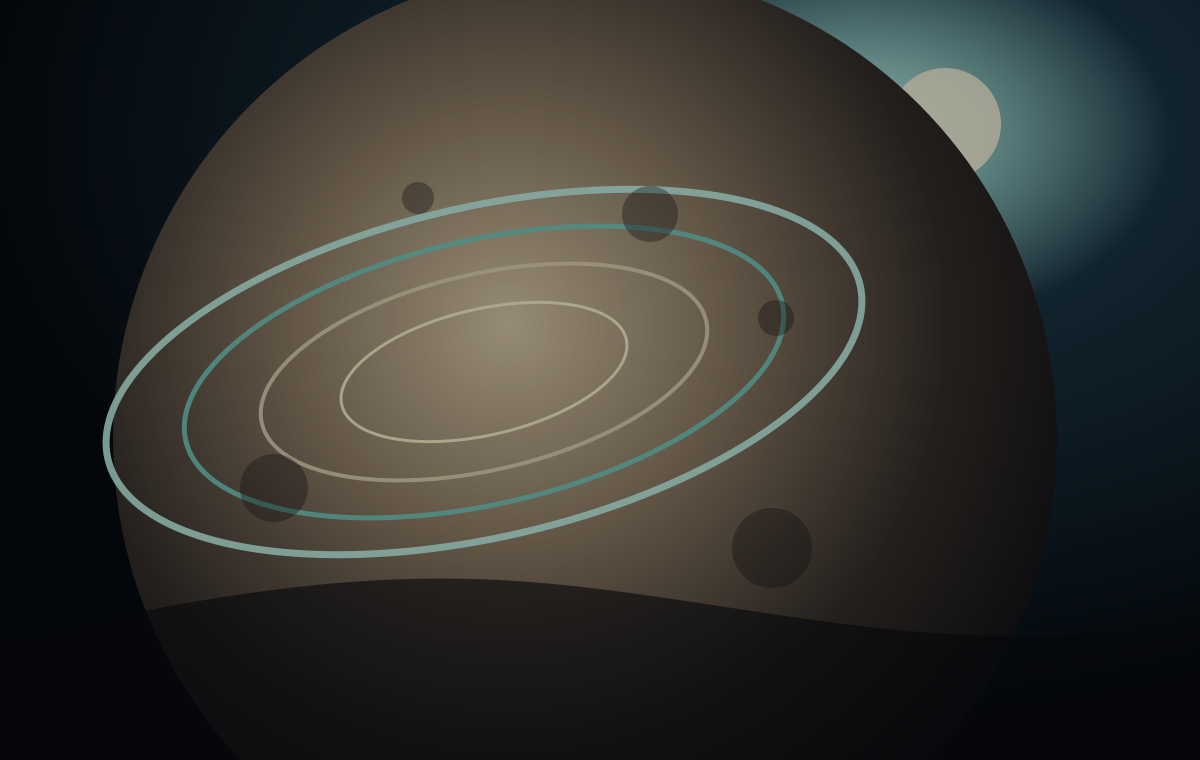
If verified imagery is not enough, the profile receives a scientific reconstruction: not fantasy in place of fact, but a visual hypothesis clearly separated from sources.
World paletteicy turquoise, deep space, and distant moons

Visual reconstruction
Reverse reconstruction → Chronological inversion → Bidirectional analysis → The present as an archive of the future
Every profile needs a visualization preview: an existing image, an aesthetically treated source, or a scientific reconstruction.
Research history
The name was adopted by the IAU in 1979, reflecting the tradition of naming Ganymede features from mythological stories.
Sources
- Last reviewed
- 2026-05-08
- Source baseline
- Gazetteer of Planetary Nomenclature; NASA Image and Video Library
- Uncertainty note
- Seed record: coordinates and diameter support navigation, while geology, age, and visual rights need enrichment.
Education mode
Facts
- Official diameter: about 153 km.
- The name refers to the Assyro-Babylonian epic.
- Useful for future comparison with lunar and Martian craters.