Why it matters
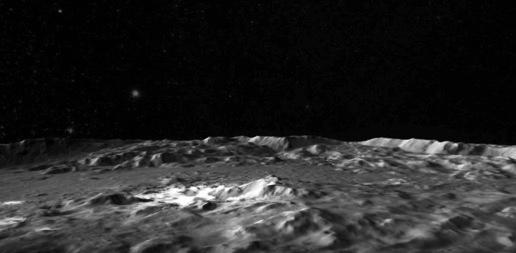
Valhalla shows that in the outer Solar System a crater can be not a bowl, but an entire planetary-scale ring system.
Measurements and uncertainty
Extended record: core parameters have an editorial baseline, while age, depth, and preservation still require primary-source review.
Scientific profile
Valhalla's rings read as the response of an ice-rock crust to a giant impact, useful for comparing impact mechanics across small and large bodies.
Reconstruction gallery
More visual readings of the crater
If verified imagery is not enough, the profile receives a scientific reconstruction: not fantasy in place of fact, but a visual hypothesis clearly separated from sources.
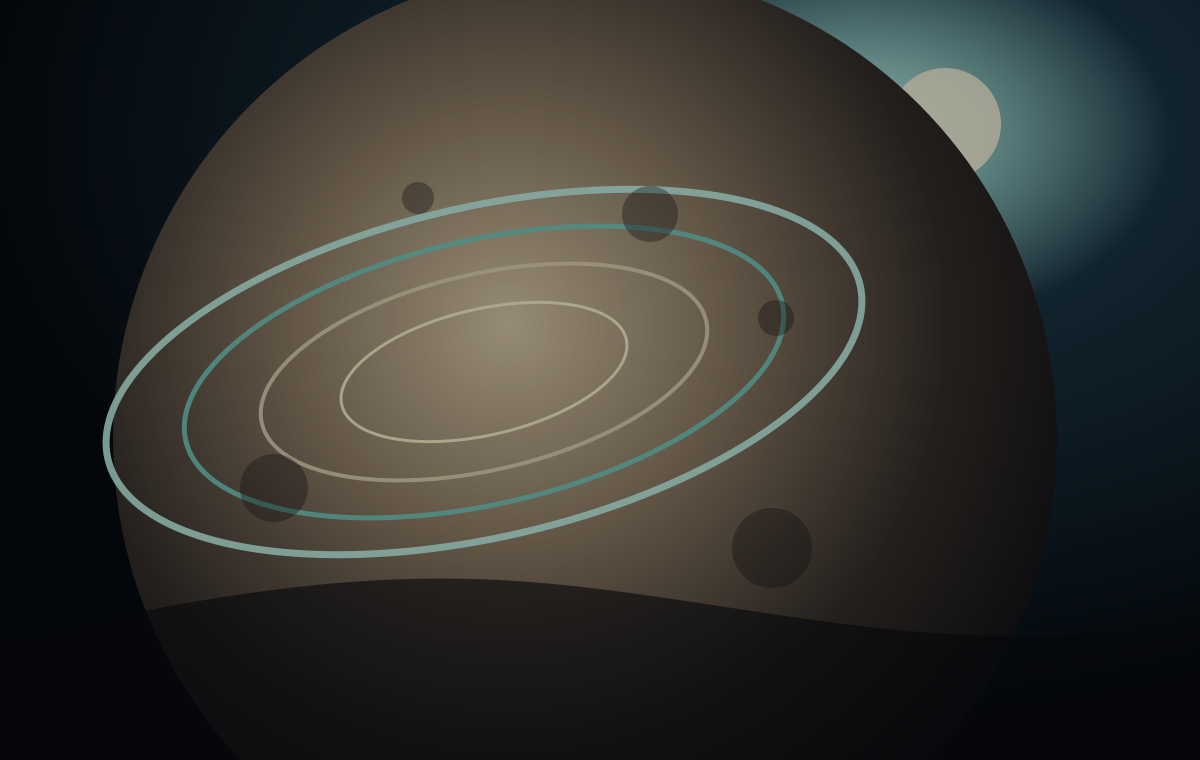
Visual reconstruction
Reverse reconstruction → Chronological inversion → Bidirectional analysis → The present as an archive of the future
Every profile needs a visualization preview: an existing image, an aesthetically treated source, or a scientific reconstruction.
Research history
The feature is listed in the IAU/USGS planetary nomenclature and is known from missions to the Jupiter system.
Sources
- Last reviewed
- 2026-05-08
- Source baseline
- Gazetteer of Planetary Nomenclature; NASA Image and Video Library
- Uncertainty note
- Extended record: core parameters have an editorial baseline, while age, depth, and preservation still require primary-source review.
Education mode
Facts
- Official Gazetteer diameter: about 3000 km.
- The name refers to Valhalla from Norse mythology.
- For the site, it anchors the Jupiter-moons branch.