Why it matters
Occator shows why Other Worlds matters: small bodies offer a very different geological drama.
Measurements and uncertainty
Diameter92 km
Depthnot listed
Ageyoung for Ceres
StatusConfirmed
Coordinates19.800° N / 120.700° W
Record levelextended
Extended record: core parameters have an editorial baseline, while age, depth, and preservation still require primary-source review.
Scientific profile
Bright spots are linked to salts and possible late activity, complicating the idea of a crater as a passive bowl.
Data provenanceNASA Image and Video Library; Gazetteer of Planetary Nomenclature
Reconstruction gallery
More visual readings of the crater
If verified imagery is not enough, the profile receives a scientific reconstruction: not fantasy in place of fact, but a visual hypothesis clearly separated from sources.
World paletteicy turquoise, deep space, and distant moons
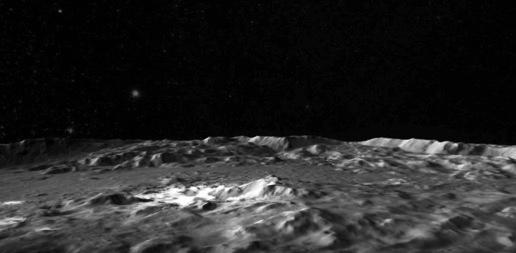
Visual reconstruction
Reverse reconstruction → Chronological inversion → Bidirectional analysis → The present as an archive of the future
Every profile needs a visualization preview: an existing image, an aesthetically treated source, or a scientific reconstruction.
Research history
Dawn studied the crater in detail, turning Ceres from a distant dot into a geological world.
Sources
- Last reviewed
- 2026-05-08
- Source baseline
- NASA Image and Video Library; Gazetteer of Planetary Nomenclature
- Uncertainty note
- Extended record: core parameters have an editorial baseline, while age, depth, and preservation still require primary-source review.
Education mode
Facts
- The bright Cerealia Facula lies inside the crater.
- The feature connects to volatile materials on small bodies.