Why it matters
Gale shows how a crater can become an archive of sediments, water, and climate.
Measurements and uncertainty
Diameter154 km
Depthnot listed
Agemore than 3.5 billion years
StatusConfirmed
Coordinates5.400° S / 137.800° E
Record levelextended
Extended record: core parameters have an editorial baseline, while age, depth, and preservation still require primary-source review.
Scientific profile
Layers in the central mound and floor materials record long histories of sedimentation, aeolian reworking, and possible watery conditions.
Data provenanceNASA Image and Video Library
Reconstruction gallery
More visual readings of the crater
If verified imagery is not enough, the profile receives a scientific reconstruction: not fantasy in place of fact, but a visual hypothesis clearly separated from sources.
World paletteMartian rust, dust, and ochre
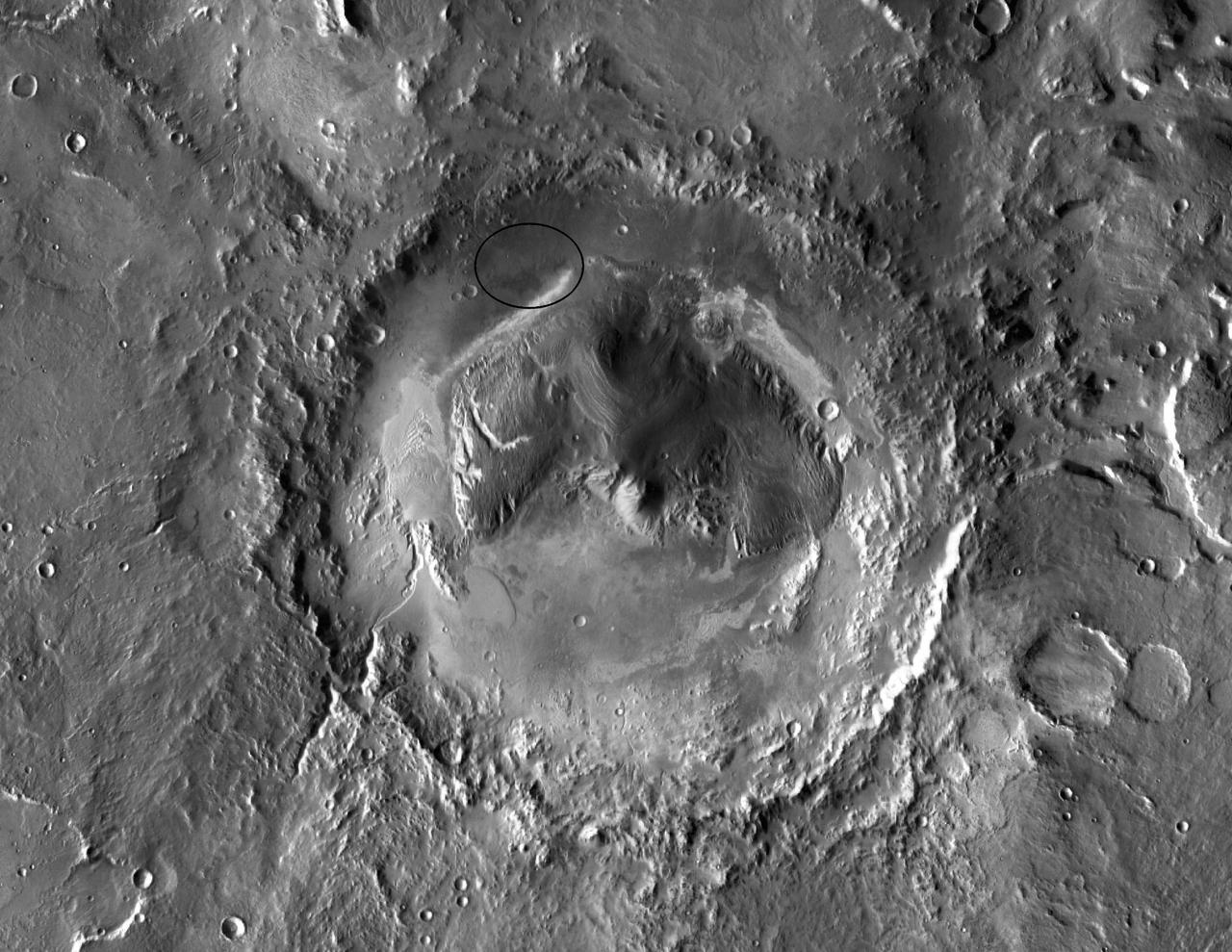
Visual reconstruction
Reverse reconstruction → Chronological inversion → Bidirectional analysis → The present as an archive of the future
Every profile needs a visualization preview: an existing image, an aesthetically treated source, or a scientific reconstruction.
Research history
Since 2012, Curiosity has made Gale one of the most intensively studied places on Mars.
Sources
- Last reviewed
- 2026-05-08
- Source baseline
- NASA Image and Video Library
- Uncertainty note
- Extended record: core parameters have an editorial baseline, while age, depth, and preservation still require primary-source review.
Education mode
Facts
- Its center contains Aeolis Mons, known as Mount Sharp.
- Curiosity studies layers that help reconstruct ancient environments.